
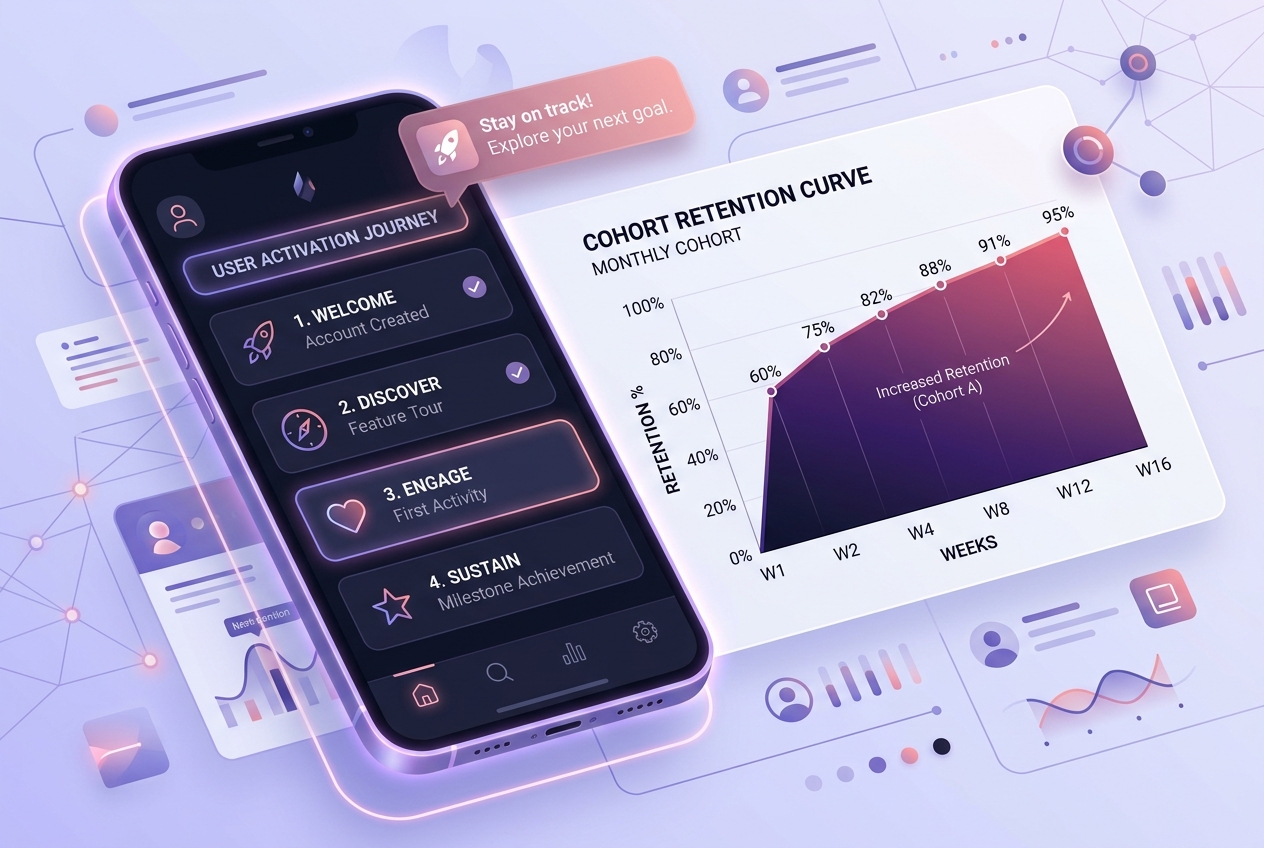
An activation event should indicate that a user has experienced meaningful value, not merely completed setup. Define that event before redesigning onboarding so the team optimizes for customer progress rather than form completion.
Start with the customer’s intended result
Ask what the app helps someone accomplish and what observable behavior suggests they accomplished it. For a note-taking app, creating an account may be necessary, but retrieving a useful note later could be more meaningful.
Avoid selecting an event simply because it is easy to instrument. A convenient proxy can become misleading when the team starts optimizing around it.
Validate the hypothesis
Compare the behavior with later retention or paid use, while remembering that correlation does not prove causation. Speak with users to understand why they completed or abandoned the task. Combine behavioral evidence with the actual experience.
Segment by use case when necessary. A professional using the app weekly may not share the same activation moment as a casual daily user.
Remove friction around value
Map the steps required to reach the event. Identify which inputs are essential now and which can wait. Provide an understandable example or default when it helps users experience the product without excessive setup.
Do not remove useful choices merely to make the funnel shorter. The aim is a clearer path to value, not the smallest possible number of screens.
Evaluate the redesign honestly
Track activation alongside later behavior and error signals. A forced tutorial can increase completion while reducing willingness to return. Use consistent cohort definitions and allow enough time for the relevant usage cycle.
The activation definition should remain open to revision as the product evolves. It is a working model of value, not a permanent truth. When the team agrees on that model, onboarding design becomes a focused effort to help users reach a meaningful outcome sooner.