
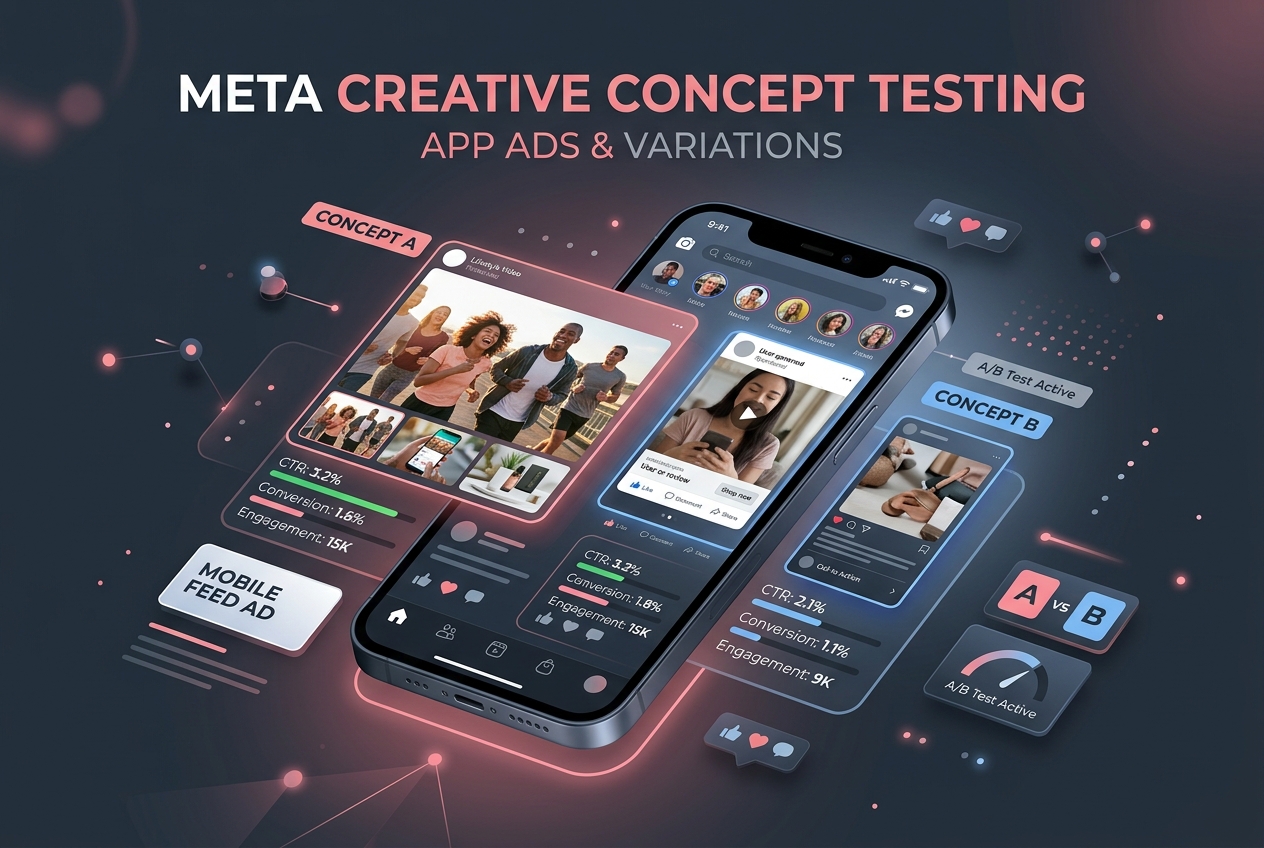
A useful Meta creative test compares different reasons to care about the app. Changing only a background color can refine an existing idea, but it rarely reveals whether the underlying promise is the right one.
Write the hypothesis before the asset
Describe the audience, the problem and the message you expect to resonate. For an illustrative language app, one concept might emphasize travel confidence while another emphasizes a small daily habit. Each should lead to a product experience that fulfills that promise.
Keep a control and assign clear names to concepts, formats and versions. Without naming discipline, the next report becomes a list of thumbnails rather than a record of learning.
Separate idea from execution
A weak execution can hide a strong concept. Before rejecting a message, check that the hook is understandable, the interface is visible and the call to action is coherent. Conversely, strong attention metrics do not establish that the audience is commercially valuable.
Build a manageable testing matrix. Too many simultaneous variants can dilute the available evidence and overwhelm production without improving the decision.
Look after the click
Compare meaningful app events, not only ad engagement. A dramatic hook may generate curiosity while creating a poor match with the store listing or onboarding. Review the whole journey when a high-click ad produces weak activation.
Confirm event definitions and attribution settings with the measurement owner. Differences between platform and internal reports should be investigated rather than averaged away.
Turn the result into the next brief
Record what the test supports, what it does not explain and which follow-up would resolve the uncertainty. A winning format can be adapted to another use case, but do not assume the message transfers automatically to a different audience or market.
The output of creative testing should be a growing understanding of the customer. If the only conclusion is “make ten more like this,” the team is missing an opportunity to build a more durable creative strategy.